字数
1510 字
阅读时间
8 分钟
Gin 的本质
go
authorized.Use(fun(c  *gin.Context){ c.Next() })
	{
      authorized.Group("/v1")   //  路由组的第二个参数同样支持回调函数: fun(c  *gin.Context){ ...省略代码  }
      {
            authorized.POST("/login", fun(c  *gin.Context){
                 c.PostForm("userName")
            })

            authorized.POST("/update", fun(c  *gin.Context){
                 c.PostForm("userName")
            })
       }
	}****
gin 路由包的的中间件、路由组、路由本质都是采用的回调函数在处理后续的逻辑,回调函数最大的数量为 63 个.
源码
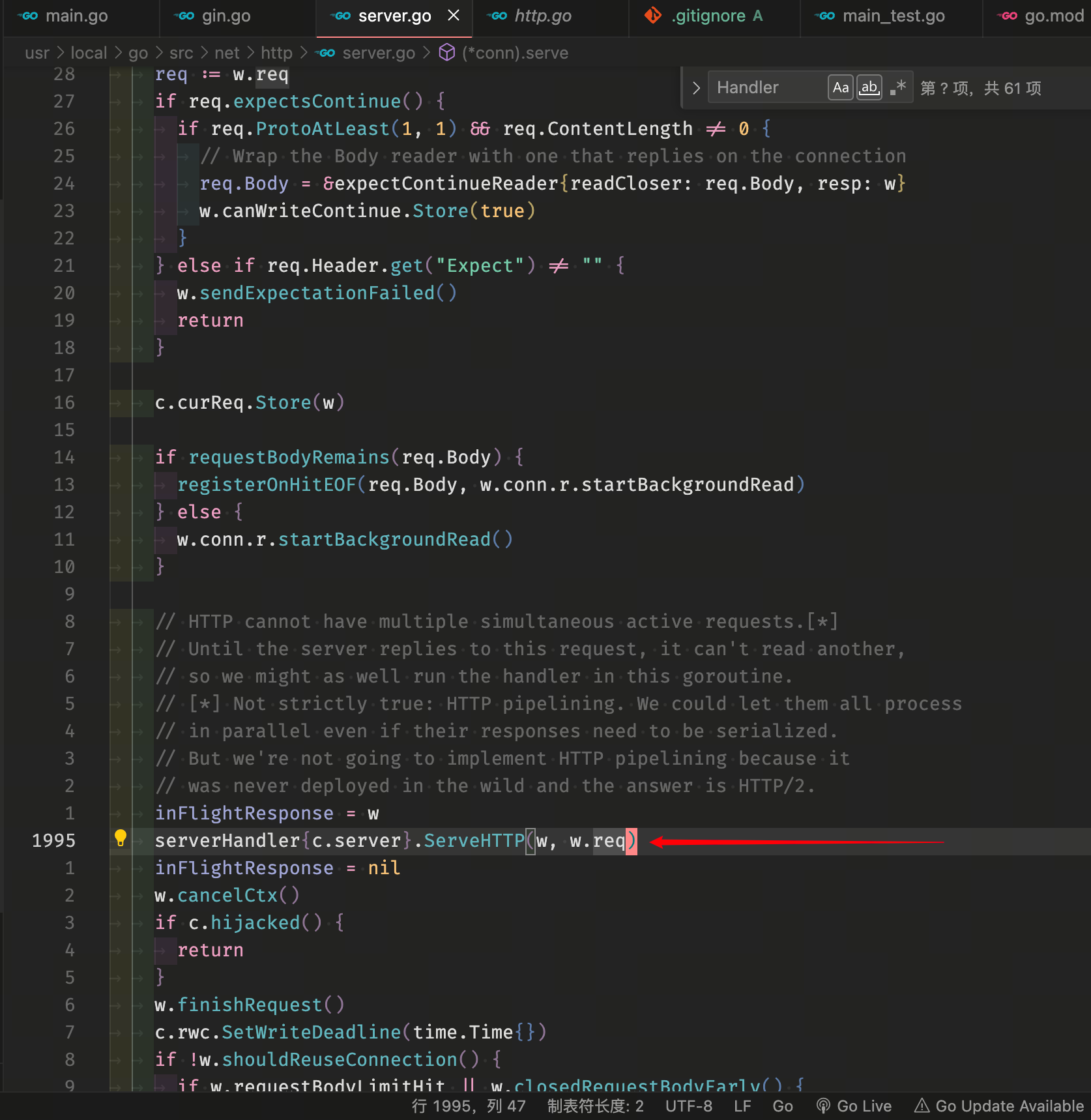
- HTTP 不能同时具有多个活动请求。
- 在服务器回复此请求之前,它无法读取另一个请求,
- 所以我们可以在当前 goroutine 中运行处理程序。
- 这并不完全正确:HTTP 流水线技术。即使它们的响应需要串行化,我们也可以让它们并行处理
- 但我们不打算实现 HTTP 流水线技术,因为它从未在实际环境中部署过,而 HTTP/2 则提供了解决方案。
txt
这段代码是一个`conn`结构体的方法`serve`,该方法用于处理一个新的连接。主要功能如下:

1. 设置远程地址和本地地址。
2. 如果是TLS连接,则进行TLS握手。
3. 如果是HTTP/1.x协议,则读取请求并处理。
4. 如果是HTTP/2协议,则调用对应的处理函数。
5. 处理完请求后,检查是否需要关闭连接或继续复用连接。

具体实现细节如下:

- 在函数结尾处使用`defer`语句,用于处理异常情况,比如发生`panic`。如果发生`panic`,会将错误信息打印出来,并取消正在处理的请求。
- 如果是TLS连接,则设置TLS握手超时时间,并进行TLS握手。如果握手失败,则根据错误类型进行处理,比如对于不支持TLS的客户端,返回一个400响应。
- 如果是HTTP/1.x协议,则使用`readRequest`函数读取请求。如果读取失败,根据不同的错误类型,返回对应的错误响应。
- 如果请求需要进行100 Continue支持,则根据请求的协议版本和内容长度,决定是否发送100 Continue响应。
- 注册一个回调函数,在请求的`Body`读取完毕后,启动一个后台读取任务。
- 调用`serverHandler`的`ServeHTTP`方法来处理请求。
- 处理完请求后,根据是否需要复用连接和服务器是否处于关闭模式,决定是否关闭连接或继续复用连接。
- 如果需要复用连接,并且服务器设置了空闲超时时间,则设置读取截止时间,并等待连接再次可读。
- 最后,使用`bufr.Peek`方法判断连接是否可读,如果不可读,则结束处理。
go
func (c *conn) serve(ctx context.Context) {
	c.remoteAddr = c.rwc.RemoteAddr().String()
	ctx = context.WithValue(ctx, LocalAddrContextKey, c.rwc.LocalAddr())
	var inFlightResponse *response
	defer func() {
		if err := recover(); err != nil && err != ErrAbortHandler {
			const size = 64 << 10
			buf := make([]byte, size)
			buf = buf[:runtime.Stack(buf, false)]
			c.server.logf("http: panic serving %v: %v\n%s", c.remoteAddr, err, buf)
		}
		if inFlightResponse != nil {
			inFlightResponse.cancelCtx()
		}
		if !c.hijacked() {
			if inFlightResponse != nil {
				inFlightResponse.conn.r.abortPendingRead()
				inFlightResponse.reqBody.Close()
			}
			c.close()
			c.setState(c.rwc, StateClosed, runHooks)
		}
	}()

	if tlsConn, ok := c.rwc.(*tls.Conn); ok {
		tlsTO := c.server.tlsHandshakeTimeout()
		if tlsTO > 0 {
			dl := time.Now().Add(tlsTO)
			c.rwc.SetReadDeadline(dl)
			c.rwc.SetWriteDeadline(dl)
		}
		if err := tlsConn.HandshakeContext(ctx); err != nil {
			// If the handshake failed due to the client not speaking
			// TLS, assume they're speaking plaintext HTTP and write a
			// 400 response on the TLS conn's underlying net.Conn.
			if re, ok := err.(tls.RecordHeaderError); ok && re.Conn != nil && tlsRecordHeaderLooksLikeHTTP(re.RecordHeader) {
				io.WriteString(re.Conn, "HTTP/1.0 400 Bad Request\r\n\r\nClient sent an HTTP request to an HTTPS server.\n")
				re.Conn.Close()
				return
			}
			c.server.logf("http: TLS handshake error from %s: %v", c.rwc.RemoteAddr(), err)
			return
		}
		// Restore Conn-level deadlines.
		if tlsTO > 0 {
			c.rwc.SetReadDeadline(time.Time{})
			c.rwc.SetWriteDeadline(time.Time{})
		}
		c.tlsState = new(tls.ConnectionState)
		*c.tlsState = tlsConn.ConnectionState()
		if proto := c.tlsState.NegotiatedProtocol; validNextProto(proto) {
			if fn := c.server.TLSNextProto[proto]; fn != nil {
				h := initALPNRequest{ctx, tlsConn, serverHandler{c.server}}
				// Mark freshly created HTTP/2 as active and prevent any server state hooks
				// from being run on these connections. This prevents closeIdleConns from
				// closing such connections. See issue https://golang.org/issue/39776.
				c.setState(c.rwc, StateActive, skipHooks)
				fn(c.server, tlsConn, h)
			}
			return
		}
	}

	// HTTP/1.x from here on.

	ctx, cancelCtx := context.WithCancel(ctx)
	c.cancelCtx = cancelCtx
	defer cancelCtx()

	c.r = &connReader{conn: c}
	c.bufr = newBufioReader(c.r)
	c.bufw = newBufioWriterSize(checkConnErrorWriter{c}, 4<<10)

	for {
		w, err := c.readRequest(ctx)
		if c.r.remain != c.server.initialReadLimitSize() {
			// If we read any bytes off the wire, we're active.
			c.setState(c.rwc, StateActive, runHooks)
		}
		if err != nil {
			const errorHeaders = "\r\nContent-Type: text/plain; charset=utf-8\r\nConnection: close\r\n\r\n"

			switch {
			case err == errTooLarge:
				// Their HTTP client may or may not be
				// able to read this if we're
				// responding to them and hanging up
				// while they're still writing their
				// request. Undefined behavior.
				const publicErr = "431 Request Header Fields Too Large"
				fmt.Fprintf(c.rwc, "HTTP/1.1 "+publicErr+errorHeaders+publicErr)
				c.closeWriteAndWait()
				return

			case isUnsupportedTEError(err):
				// Respond as per RFC 7230 Section 3.3.1 which says,
				//      A server that receives a request message with a
				//      transfer coding it does not understand SHOULD
				//      respond with 501 (Unimplemented).
				code := StatusNotImplemented

				// We purposefully aren't echoing back the transfer-encoding's value,
				// so as to mitigate the risk of cross side scripting by an attacker.
				fmt.Fprintf(c.rwc, "HTTP/1.1 %d %s%sUnsupported transfer encoding", code, StatusText(code), errorHeaders)
				return

			case isCommonNetReadError(err):
				return // don't reply

			default:
				if v, ok := err.(statusError); ok {
					fmt.Fprintf(c.rwc, "HTTP/1.1 %d %s: %s%s%d %s: %s", v.code, StatusText(v.code), v.text, errorHeaders, v.code, StatusText(v.code), v.text)
					return
				}
				publicErr := "400 Bad Request"
				fmt.Fprintf(c.rwc, "HTTP/1.1 "+publicErr+errorHeaders+publicErr)
				return
			}
		}

		// Expect 100 Continue support
		req := w.req
		if req.expectsContinue() {
			if req.ProtoAtLeast(1, 1) && req.ContentLength != 0 {
				// Wrap the Body reader with one that replies on the connection
				req.Body = &expectContinueReader{readCloser: req.Body, resp: w}
				w.canWriteContinue.Store(true)
			}
		} else if req.Header.get("Expect") != "" {
			w.sendExpectationFailed()
			return
		}

		c.curReq.Store(w)

		if requestBodyRemains(req.Body) {
			registerOnHitEOF(req.Body, w.conn.r.startBackgroundRead)
		} else {
			w.conn.r.startBackgroundRead()
		}

		// HTTP cannot have multiple simultaneous active requests.[*]
		// Until the server replies to this request, it can't read another,
		// so we might as well run the handler in this goroutine.
		// [*] Not strictly true: HTTP pipelining. We could let them all process
		// in parallel even if their responses need to be serialized.
		// But we're not going to implement HTTP pipelining because it
		// was never deployed in the wild and the answer is HTTP/2.
		inFlightResponse = w
		serverHandler{c.server}.ServeHTTP(w, w.req)
		inFlightResponse = nil
		w.cancelCtx()
		if c.hijacked() {
			return
		}
		w.finishRequest()
		c.rwc.SetWriteDeadline(time.Time{})
		if !w.shouldReuseConnection() {
			if w.requestBodyLimitHit || w.closedRequestBodyEarly() {
				c.closeWriteAndWait()
			}
			return
		}
		c.setState(c.rwc, StateIdle, runHooks)
		c.curReq.Store(nil)

		if !w.conn.server.doKeepAlives() {
			// We're in shutdown mode. We might've replied
			// to the user without "Connection: close" and
			// they might think they can send another
			// request, but such is life with HTTP/1.1.
			return
		}

		if d := c.server.idleTimeout(); d != 0 {
			c.rwc.SetReadDeadline(time.Now().Add(d))
		} else {
			c.rwc.SetReadDeadline(time.Time{})
		}

		// Wait for the connection to become readable again before trying to
		// read the next request. This prevents a ReadHeaderTimeout or
		// ReadTimeout from starting until the first bytes of the next request
		// have been received.
		if _, err := c.bufr.Peek(4); err != nil {
			return
		}

		c.rwc.SetReadDeadline(time.Time{})
	}
}
贡献者
 jiechen